
No need for lactate testing!
... use Threshold Power instead - for free.

Contents
Power has five fundamental concepts
The concepts work together to enable you to run your personal best.
Power = Effort - covered in a previous post
Threshold Power - the topic of this post
Power-Duration - will be covered in a future post
Training Stress - will be covered in a future post
Running Effectiveness - will be covered in a future post
What is Threshold Power?
Threshold Power is best understood by understanding what happens to your body when you exercise.
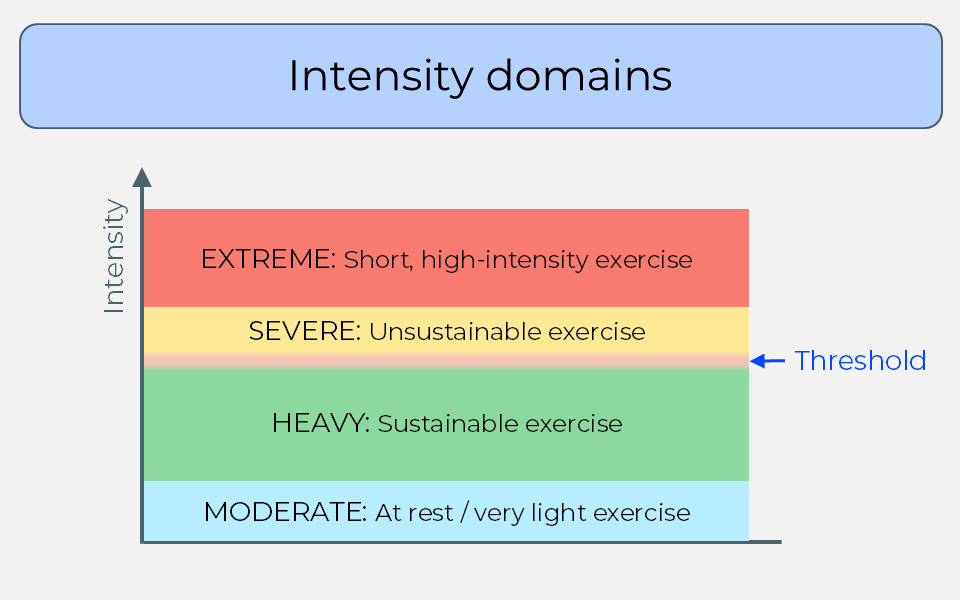
The following summarises Burnley; Exercise intensity domains and phase transitions.
If you run at lower intensity levels, you can sustain the intensity for an extended period, typically more than 30 minutes, and your body achieves a metabolic steady(ish) state. Steady(ish)? There are variations in your metabolism, but they don’t prevent you from maintaining the intensity at which you’re running. Researchers call these domains ‘moderate to heavy.’
Researchers use blood lactate to differentiate between moderate and heavy, but an easy way to tell the difference when running is to use the ‘talk test’ – if you can hold a conversation while running, you’re running at a moderate intensity; if not, you’re running at a heavy intensity.
Moderate – your body is at rest or completing very light exercise;
you can pass the ‘talk test’.
Heavy – you can maintain a steady(ish) exercise intensity;
you can’t pass the ‘talk test’.
If, instead, you run at higher intensity levels, you won’t be able to achieve a metabolic steady(ish) state. You’ll fatigue much more rapidly and need to slow down or stop – typically within 30 minutes. Researchers call the domains where you fatigue much more quickly ‘severe to extreme’ domains. Note that the actual duration may vary, with some runners able to run at higher intensities for up to 60-70 minutes.
The change from heavy to severe doesn’t happen at a precise point – it’s a phase transition over a narrow range of intensities, with lots of metabolic changes occurring at different rates and in parallel. Researchers have identified several markers that can be lab-tested to identify the transition from heavy to severe – one well-known marker is Maximum Lactate Steady State (MLSS), but there are many others.
Many runners are familiar with VO2max which, according to Wikipedia, is ‘the maximum rate of oxygen consumption attainable during physical exertion’. VO2max is above the heavy domain, but it too does not have a single point at which it occurs, and you cannot reach VO2max from all higher intensities – some intensities are too high and lead to fatigue failure before you attain VO2max. There is broad acceptance among researchers that intensities below VO2max are severe, while intensities above VO2max are extreme, but this distinction isn’t universally used.
Severe – you can’t maintain a steady(ish) exercise intensity
but may still reach VO2max.
Extreme – you can’t maintain a steady(ish) exercise intensity
and will experience fatigue failure before reaching VO2max.
The phase transition between heavy and severe has many names (as many as there are markers) – Anaerobic Threshold, LT2, Lactate Turn Point, VT2, Critical Power, Functional Threshold Power and more.
For convenience in this post, I’ll refer to the phase transition from heavy to severe as ‘Threshold’.
Threshold Power is an intensity that’s within (or close to) Threshold.
Threshold Power:
✅ is highly correlated with speed in endurance events – from 5k through marathon and beyond
✅ can be identified using field-based tests – no need for lab-based testing
✅ can be improved with training – improve your threshold, and you’ll improve your performance
✅ is an important representation of your running fitness – it should be tracked as part of your training
How do you identify your Threshold Power?
Identifying Threshold Power uses specific test protocols.
These rely on regular maximum effort runs, which you should include as part of your training.
Test Protocols
The three most commonly used protocols are a Critical Power test (CP), modelled Functional Threshold Power (FTP) and Automatically calculated Critical Power (Auto-CP).
The three protocols differ but are similar in their approach and purpose – they:
🔹 use the results from two or more maximum effort runs at differing durations
🔹 identify a power level that’s close to (or within) your threshold
Maximum Effort runs
The test protocols rely on maximum effort runs. These are runs at the highest effort you can maintain for a specific duration.
For example, your 3-minute maximum effort is the maximum power you can maintain for 3 minutes (elapsed).
Maximum Effort runs are different than Best Effort runs, which are simply your best effort (so far) over a specific duration - whether you were trying to run your best or not.
Maximum Effort runs are runs where you set out to run the highest effort you can maintain for a specific duration
Do you have to use Maximum Effort runs?
Maximum effort runs represent the best that you’re capable of at a point in time. Without maximum effort runs, you will likely underestimate your threshold power. This will lower your training targets, understate your training load, and your race/event targets will not truly represent what you’re capable of.
But there may be times when maximum effort runs won’t be possible, for example, if you’re new to running, or you’re recovering from injury.
It is possible to estimate your threshold power using easy runs, but this method is only recommended until you’re able to complete maximum effort runs.
If you’re familiar with the game of darts, estimating your threshold power using easy runs is like hitting the dartboard – at least you can start training.
Whereas maximum effort runs and a field-based test protocol is like hitting much nearer (or within) the number you were aiming at.
What’s your Threshold Power used for?
Your Threshold Power is used to …
… set training targets
Training targets are set as a percentage of Threshold Power for all types of workouts (long runs, intervals etc.)
The percentages vary depending on the purpose of the workout and the ability of the runner. But they all have one thing in common – they are based on your threshold, which means:
🔹 they are based on your current running fitness – what you can achieve right now (without over- or under-training).
🔹 your workout targets self-adjust if your threshold changes
… monitor training load
Training stresses your body and, if done correctly, encourages it to adapt.
Running with Power uses Stress Scores to monitor your training load. Stress scores represent the physical and metabolic stress of each workout.
Stress scores are relative to your Threshold Power, so that if your threshold changes, stress scores stay aligned to your threshold and to your ability to cope with the training.
… set race/event targets
Your Threshold Power is a key measure of your running fitness. On race day, your finish time will depend to a large extent on your running fitness.
To plan your race-day target power based on your race-day fitness, it’s essential to know your Threshold Power.
What’s the difference between … ?
Threshold Power and VO2max?
Running Threshold Power and Threshold Power (or FTP) in other sports?
Threshold Power vs. VO2max
VO2max is a measure of your body’s maximum aerobic capacity. Threshold power (or FTP) is the highest intensity you can maintain without rapidly fatiguing and needing to slow down or stop.
Think of VO2max as ‘the size of your engine’, and Threshold Power as ‘your highest cruising speed’. A bigger VO2max means you could go further and faster, but it doesn’t mean you’ll use that capacity effectively; a higher cruising speed means you can travel faster for a sustained period of time.
Both are important, but of the two, Threshold Power is more actionable, and a more direct and practical predictor of performance.
Running Threshold Power and Threshold Power (or FTP) in other sports
Your running Threshold Power is unrelated to your cycling or swimming (or rowing) Threshold Power, even if the numbers appear similar and even though they’re based on your physiology.
This is because different sports use different muscles and limb movements, have different elastic energy contributions (from your tendons being tensioned and released) and use different power meters.
You should calculate and track Threshold Power separately for each sport – don’t mix and match.
Which Threshold Power protocol is best?
This is a common question for runners new to power and wanting to ensure an accurate Threshold Power.
Which protocol results in the most accurate Threshold Power?
Any of the three most commonly used protocols (CP, FTP or Auto-CP).
Why?
Your threshold is a ‘phase transition’ over a narrow range of intensities, with lots of metabolic changes occurring at different rates and in parallel. And your Threshold Power is an intensity that’s within (or close to) the phase transition.
In this context, any of the three most commonly used protocols can produce a usable Threshold Power.
Which should you use?
The answer typically depends on the app you’re using to review your power metrics:
🔹 Using WKO? You’ll most likely use auto-calculated FTP.
🔹 Using Stryd PowerCenter? You’ll most likely use Auto-CP.
🔹 Using another app? You’ll most likely use CP tests.
Do all three protocols give the same result?
No.
It’s likely that each will give a slightly different result, although the Threshold Power numbers are usually within 2-3% of each other.
And if you have multiple Threshold Power numbers to choose from, choose the lowest. This means your training targets will err on the side of under-training, rather than erring on the side of over-training (and an increased risk of injury).
In Summary
Running with Power’s key metric is your Threshold Power - it:
📈 is an intensity that’s within (or close to) the physiological threshold between ‘heavy’ and ‘severe’ intensity levels
🏃🏼♀️ is highly correlated with speed in endurance events – from 5k through marathon and beyond
🧪 can be identified using field-based tests – no need for lab-based testing
👟 can be improved with training – improve your threshold, and you’ll improve your performance
Your Threshold Power is an important representation of your running fitness, used to:
👉🏼 set training targets – targets that ‘self-adjust’ as your Threshold Power improves
👉🏼 monitor training load – using metrics relative to your Threshold Power (your current fitness)
👉🏼 set race/event targets – to calculate your race-day target power based on your race-day fitness